Minimalist iPhone puzzle about shifting arrows through mazes
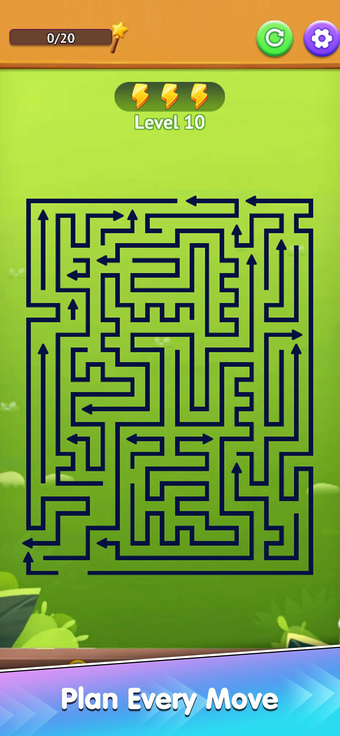
Arrow Shift Path, developed by Tahajeeb Hazir, is a minimalist strategy puzzle for iPhone that asks players to plan routes through shifting mazes. The core task is guiding arrows across a dynamic grid until they reach an endpoint, relying on sequence and timing to clear each route. Levels pair logic-based layouts with real-time maze transformations and a calm visual aesthetic. Casual mobile players and puzzle fans gain relaxed, non-timed challenges that reward observation and ordered moves.
What kind of puzzle is this compared with other minimalist hits?
Unlike perspective-based puzzlers such as Monument Valley, this title centers on route sequencing and logical order rather than spatial rotation. The game emphasizes careful move ordering to solve each layout, with an explicit focus on path planning and logical thinking. Real-time maze transformations keep the sequence unpredictable, which shifts the experience from decorative puzzle presentation to a compact exercise in anticipating how one action affects later options.
Does it offer multiple modes and how do controls work?
The product is presented as a single-player puzzle experience that functions offline, with no mention of multiplayer or co-op. Controls use simple touch gestures to advance pieces across the grid, and the level structure follows a progressive difficulty curve that introduces more complex layouts as you advance. Compatibility includes iPhone, iPad, and Mac with Apple silicon, which lets players move between handheld and desktop play without network dependence.
How does the interface and visual design support play?
The visual approach keeps screens sparse and deliberately calm, prioritizing clarity over decoration. Interface elements avoid clutter, and the layout highlights arrows, endpoints, and shifting lanes so players can scan potential sequences quickly. The distraction-free presentation helps maintain focus during longer puzzles, while clear visual contrast between active and inactive tiles reduces visual ambiguity when planning multi-step routes.
Is the learning curve fair and what drives replay value?
The progression relies on increasing layout complexity rather than time pressure, introducing patterns that demand order-sensitive moves. Players encounter 'aha' moments when a correct sequence resolves a tangled maze, a reaction noted in early user feedback. Replay value comes from layout variety and the unpredictability of maze shifts, which encourage revisiting levels to find alternate sequences or more efficient routings.
In summary, a contemplative pick for methodical puzzle players
In summary, Arrow Shift Path is a contemplative choice for players who enjoy methodical, sequence-driven puzzles and calm, focused sessions. The game's single-player, logic-first design makes it well suited to solitary problem solvers who prefer thinking over reflexes. A narrower audiovisual scope and the absence of social modes mean it is less appropriate for players seeking narrative depth or multiplayer variety.